Some dogs were born to run — and some were born to run while pulling sleds or wagons behind them. If you have a dog like that, what’s more fun than watching him run with the joy of pulling cargo? When I run behind Shadow, our husky/standard poodle mix, he is beautiful, muscles rippling, doing what he was born to do. I only wish we had known about dog scootering when Shadow was much younger.
Click here to read this article in its original magazine format with additional photos .
When our son James played football at Naperville North High School, home of the Huskies, a husky mushing team ran around the track with a dog scooter when the home team made a touchdown. We talked to the owners of the team several times, but never realized that dog scooters were available for the general consumer.
James grew up and took Shadow with him when he moved out of Naperville. We determined to get another husky-type dog and my husband Bradley wanted to make sure the dog would have an appropriate job to do, believing dogs are happiest when employed.
Bradley read up on dog scootering and how to train your dog at DogScooter.com while I, meanwhile, scoured husky rescue sites. After seeing quite a few dogs from different places, we met Cassia through Free Spirit Husky Rescue in Harvard, Illinois — and she told us she was going home with us! After going through basic obedience training with Cassia, Bradley also took a mushing class with her at Narnia Pet Behavior & Training and we were on our way to scootering.
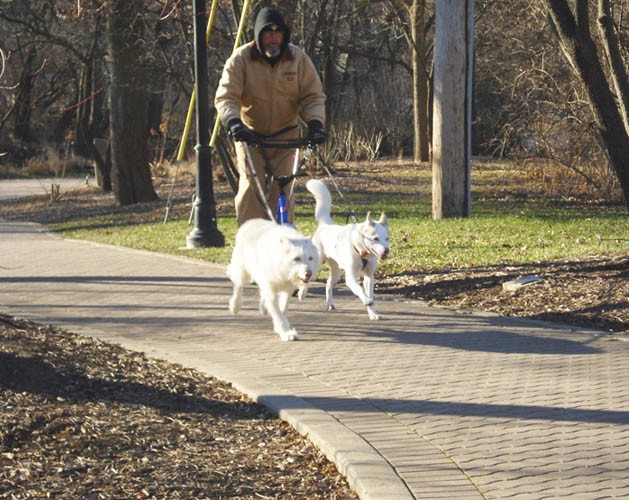
If you’ve never seen the sport in action, dog scooters are designed with hook-ups for a line to attach to the dog. The dog wears a special harness that distributes the tension and, therefore, the weight of the pull more evenly over the dog’s body. The harness is attached to the scooter with a tugline and the human stands on the scooter platform.
The ideal dog-to-human weight ratio is one to three; that is, ideally a 40 pound dog should pull no more than 120 pound person. Two 40 pound dogs can pull a 240 pound person and you can get lines to accommodate more than one dog. Of course, the dogs need to be able to work together as there is also a 10″ line that connects them so they don’t go off in different directions.
As in any dog training, there are specific commands: “line out” means to pull the line tight to get ready to run, “hike” means go, “gee” means right, “haw” means left and “whoa” means stop. One of the most important commands is “on by,” which means that even if you see a rabbit or a squirrel, you cannot give chase because you are scootering, that is your job and you have to let the distractions go “on by.” I have found that this is also helpful when just walking Cassia if she becomes too distracted. “On by” focuses her on the walk again.
When actively scootering, dogs should have a high protein diet. Lots of water should also be always available for the dog. It’s important to note that huskies, especially, often do not drink enough and moist foods like raw chicken help keep them hydrated. Cassia’s normal diet is high protein and gluten-free and we find that “home for treats” is the best way to end a good run.
After reading up on dog scootering, learning the basics and getting the equipment, Bradley began to train Cassia for the sport. The first step was to hook her up to a water-filled milk jug so she would get the feel of pulling something, but the sound of the jug scraping along the sidewalk spooked her and she tried to run away from it. Bradley decided to skip this step and went directly to the scooter.
Cassia instinctively knew what she was supposed to do and she ran, pulling Bradley for a good long run. Though huskies may be meant for this kind of activity, all dogs may love it. In fact, our Great Pyrenees/English Sheepdog mix is also learning how to scooter.
Once Cassia had the basics down, the tough part was finding a place to scooter. It is very difficult to scooter on sidewalks as you either just go around the block or must stop often to cross the street. Bradley found that a bike path provides a nice, long run and, luckily, the western suburbs have wonderful bike paths.
Bradley and Cassia have also joined the trainer they met through the Narnia class to scooter with others in the Naperville area. Dogs like to work in packs and scootering is no different. We have found that dogs, especially Cassia, get along better if they work together.
Another group Bradley found is the Windy City Mushers, which you can find on Facebook. Their stories and videos are entertaining and instructive. Something else to check out is the annual mushing event in January sponsored by Adopt a Husky at the Morton Arboretum.
Though last winter was too icy for scootering, it is a cool weather sport. It is not safe for the dog if the total of heat plus humidity index exceeds 120. Bradley uses the temperature of 50˚F as a guideline and rarely goes scootering when it is hotter than that. Cassia is the ultimate determiner, however, and if she thinks it’s too hot, they do not go.
The most important thing is that Cassia is very happy when she comes back from her scootering runs. She feels that she is doing something important — that she has a job to do and does it well. Plus, scootering is great exercise for dog and human alike. Both enjoy a long nap after a good scootering run.
So the next time you’re out on a bike path on a nice, cool day, be sure to look for the man with the scooter and white dog. Join them! Scootering is even more fun in a pack. Now, home for treats!
Dog scootering is a fun, rewarding activity that most dogs enjoy. Visit the following sites to learn more about the organizations mentioned in this article: www.DogScooter.com, www.HuskyRescue.org, www.NarniaPets.com, www.MortonArb.org and AdoptAHusky.com.
Photo courtesy of Anne Swanson: Bradley scootering with Shadow and Cassia
Recommended
Comments

.
thanks!!