TightRope CCL Surgery Offers Minimally Invasive Option for Ruptured, Torn Knee Ligaments
Does your dog love to romp and play in the snow? Play Frisbee or chase balls? How about those squirrels and rabbits provoking a full-speed sprint across your yard? These are ideal conditions for a possible knee injury for your pet.
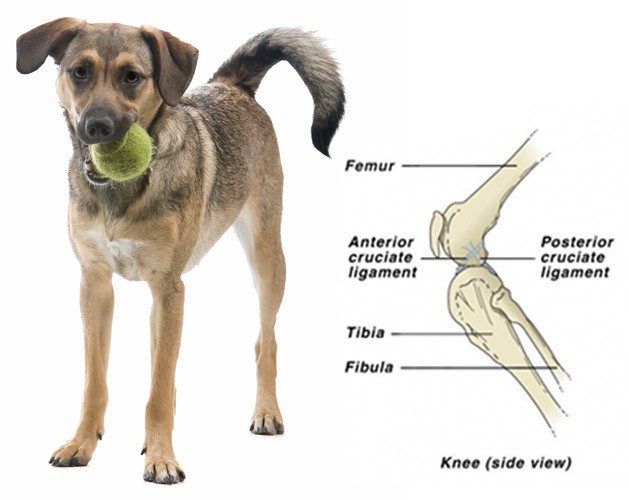
The most common orthopedic injury we see in dogs is a torn or ruptured ligament of the knee, or stifle, which is commonly referred to as a torn CCL, or the equivalent of the ACL in people. Some of the symptoms your pet may display are:
- Limping
- Holding the hind limb up
- Sitting with the leg stuck out to the side
- Stiffness, especially after exercise
- Not wanting to play or exercise
- Pain when the joint is touched or moved
- Swelling of the joint
- Clicking sound when walking
What is cranial cruciate ligament disease?
The cranial cruciate ligament (CCL) is one of the main stabilizing structures of the knee joint in the hind limbs of dogs. It is a rope-like structure inside the joint that acts as a constant stabilizer of the knee, preventing abnormal “slipping” of the two bones of the knee joint, the femur and tibia. Its main job is to hold the femur and tibia in proper alignment during all forms of activity.
Deficiency of the CCL is the most common orthopedic problem in dogs and inevitably results in degenerative joint disease (arthritis) in the knee joint. It is referred to as a disease because it is typically the result of a degenerative process in dogs, rather than from athletic injury or trauma. Although it is often noticed after running, playing or jumping, the disease process has often been present for weeks to months when symptoms occur.
There have been over 70 described techniques for the repair of CCL ruptures in dogs, with Lateral Suture Stabilization being the most common. It is one of the extracapsular techniques, which means the function of the CCL, which is inside the joint, is replaced by placing a suture outside the joint. The suture, most commonly a type of medical grade “fishing line,” is placed around the fabella and through the tibia, providing a soft tissue-to-bone stabilizer of the joint during healing. The suture acts as a temporary stabilizer as the dog makes new functional scar tissue around the knee for long-term joint stability. This surgical technique has been the standard for decades.
TightRope CCL was developed in 2005 to provide a minimally invasive and improved method for extracapsular stabilization of the CCL. This technique does not require cutting of bone like the TPLO or TTA procedures. Instead, it uses small drill holes in the femur and tibia to pass a synthetic ligament-like biomaterial through a small incision to provide bone-to-bone stabilization during healing. The biomaterial used for the TightRope CCL is called FiberTape®. This is a Kevlar-like material that is used extensively in human surgery for many orthopedic applications. What’s more, this material has properties that make it stronger and less prone to failure than any other suture materials currently being used for CCL reconstructions.
Other techniques exist. Unlike TightRope CCL, however, they are typically invasive in nature. Tibial Plateau Leveling Osteotomy (TPLO) is one of the “bone-cutting” techniques designed to change the anatomy of the knee so that it no longer “slips” without having to try to replace the function of the CCL. A semicircular cut is made at the top of the tibia with a curved saw so that the tibial joint surface is “leveled out” to prevent forward slipping of the joint. A plate and screws are inserted to stabilize the cut bone during the healing.
Tibial Tuberosity Advancement (TTA) is the other “bone-cutting” technique which is designed to change the knee anatomy so that muscle forces are rebalanced to limit the tibia from “slipping” forward. In this procedure, the bony attachment of the quadriceps muscles is cut, moved forward and held in place with a spacer, plate and screws during healing.
Neither of these techniques has been shown to have a better outcome than traditional suture techniques. Plus, the complications that can occur with these surgeries can be very difficult to manage. Determining how to repair your pets’ torn ligament can be a confusing and scary decision. Before taking any course of action, thoroughly investigate all options so you are comfortable with your choice. If you would like a consultation to see if TightRope CCL surgery may be appropriate for your pet, contact Valley Veterinary Surgery at 630-845-3066 for an appointment. Additional information is available at www.valleyveterinarysurgery.com .
About the Expert
Dr. Robert Cook graduated from the University of Illinois with a BS in Biology in 1983 and received his DVM in 1987. He founded Animal Medical Clinic of St. Charles in 1990 and began Valley Veterinary Surgery in 1999. While he still loves to be involved with daily cases, he has limited his practice to surgery, with an emphasis on minimally invasive surgical procedures and arthroscopy. Dr. Cook was part of the initial multi-center trial to evaluate the effectiveness of the Tightrope system and has been performing the procedure since the fall of 2007. In addition to having done over 2,000 repairs using this technique, Dr. Cook has also taught the technique to other veterinarians across the country.
Recommended